MRR-Weighted Feature Prioritization: Build What Your Best Customers Want
Stop treating all feature requests equally. Learn how MRR-weighted prioritization helps you focus on features that matter to your highest-paying customers.
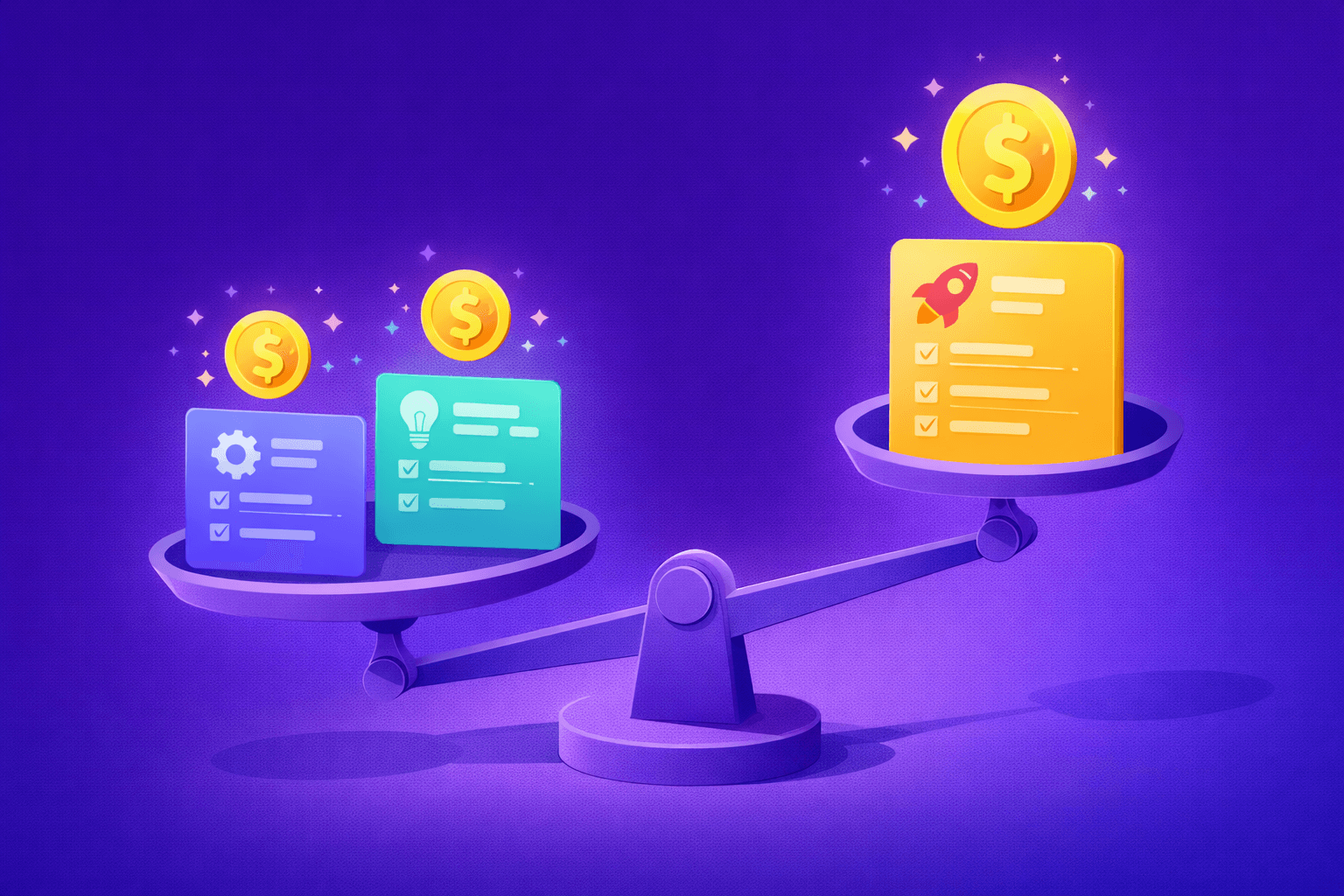
Here's a scenario every SaaS product manager knows: You have 50 feature requests in your backlog. Ten customers want Feature A, but they're all on your free tier. Two customers want Feature B, but they represent 40% of your MRR. Which do you build?
If you're treating all votes equally, you'd build Feature A. But that might be a costly mistake.
The Problem with Democratic Feature Voting
Traditional feature voting treats every user equally. One vote = one vote. This sounds fair, but it creates problems:
- Free users dominate: They often outnumber paying customers 10:1
- Enterprise needs get buried: Your biggest accounts might have unique requirements
- Revenue impact is invisible: You can't see which features affect your bottom line
What is MRR-Weighted Prioritization?
MRR-weighted prioritization assigns weight to feature requests based on the monthly recurring revenue of customers requesting them.
Instead of counting votes, you count dollars.
A Simple Example
Dark mode
- Votes: 47 (Traditional Rank: #1)
- MRR Behind Requests: $2,350 (MRR Rank: #3)
API access
- Votes: 12 (Traditional Rank: #3)
- MRR Behind Requests: $18,400 (MRR Rank: #1)
Mobile app
- Votes: 31 (Traditional Rank: #2)
- MRR Behind Requests: $8,200 (MRR Rank: #2)
With traditional voting, dark mode wins. With MRR-weighting, API access jumps to the top - because your highest-paying customers need it.
Why MRR-Weighting Works
1. Aligns Product with Revenue
Your product roadmap should support your business goals. MRR-weighting ensures you're building features that retain and expand your most valuable accounts.
2. Reduces Churn Risk
When a $5,000/month customer requests a feature, there's implicit churn risk if you ignore them. MRR-weighting surfaces these risks automatically.
3. Identifies Expansion Opportunities
Features requested by multiple high-value customers often represent market needs. Building them can help you win similar accounts.
4. Cuts Through the Noise
Instead of debating which features "feel" more important, you have objective data to guide decisions.
How to Implement MRR-Weighted Prioritization
Step 1: Connect Feature Requests to Customer Data
You need to know which customer submitted each request and their MRR. This requires:
- A feature request system that tracks customer identity
- Integration with your billing or CRM system
- A way to calculate MRR per request
Step 2: Calculate Weighted Scores
For each feature, sum the MRR of all customers requesting it:
1Feature Score = Sum of (Customer MRR for each requester)You can also factor in:
- Recency: Recent requests might indicate urgent needs
- Customer health: Requests from at-risk accounts might need priority
- Strategic accounts: Weight key logos higher
Step 3: Combine with Other Factors
MRR-weighting shouldn't be your only input. Combine it with:
- Effort estimates: A high-MRR feature that takes 6 months might not be worth it
- Strategic fit: Some features are important even without high MRR demand
- Technical dependencies: Some features unlock others
Step 4: Review Regularly
MRR changes as customers upgrade, downgrade, or churn. Review your weighted rankings monthly to keep priorities current.
Common Questions About MRR-Weighting
"Won't this ignore small customers?"
Small customers still contribute to the score - they just don't dominate it. If 100 small customers want something, that MRR adds up. MRR-weighting doesn't ignore small customers; it gives appropriate weight to everyone.
"What about features for acquisition?"
Not every feature needs to come from existing customers. Reserve capacity for:
- Features that help close deals in your pipeline
- Table-stakes features competitors have
- Strategic bets on new markets
"How do we handle enterprise custom requests?"
Enterprise customers often have unique needs. Consider:
- Tagging requests as "enterprise-specific" vs. "generally applicable"
- Weighting broadly-applicable requests higher
- Having separate capacity for enterprise customizations
Real-World Impact
Teams using MRR-weighted prioritization typically see:
- Lower churn: Building what paying customers need keeps them around
- Higher expansion revenue: Features that solve real problems lead to upgrades
- Better resource allocation: Engineering time goes to high-impact work
- Clearer communication: "This feature has $50k MRR behind it" is compelling
Getting Started
You don't need fancy tools to start. Begin with:
- Export your feature requests to a spreadsheet
- Add a column for requester MRR (pull from your billing system)
- Sum MRR for each feature
- Sort by weighted score
Once you see the value, invest in tooling that automates this process.
Conclusion
Your highest-paying customers are voting with their wallets every month. MRR-weighted prioritization ensures their needs don't get lost in a sea of free-tier requests.
Stop counting votes. Start counting revenue.
Related resources:
- MRR Tracking - How FeaturePulse tracks revenue by feature request
- MRR Tracking Integration - Set up automated MRR tracking
- Reduce Churn with Feature Prioritization - Use revenue signals to prevent churn
Related Articles
Best Feature Request Tools for iOS Apps in 2026
Compare the top feature request tools for iOS developers. FeaturePulse, WishKit, Canny, Featurebase and more. Native SDK, MRR tracking, and pricing compared.
How to Collect Feature Requests in iOS Apps: 5 Methods
Step-by-step guide to collecting feature requests from iOS users. Native SDK, best practices, and tools comparison.
Feature Prioritization for iOS Apps: Frameworks & Best Practices
Learn how to prioritize iOS app features using RICE, MRR tracking, and other proven frameworks.